Targeting clinically validated disease pathways
Our pipeline includes 2 clinical-stage product candidates, WIN378 and WIN027. WIN378 is an ultra-long-acting antibody that is designed to inhibit the TSLP ligand. WIN027 is an ultra-long-acting bispecific monoclonal antibody made to target TSLP and IL-13.
Pipeline
(ex-China)
and
Harbour BioMed
(ex-China)
Therapeutics
¹Our partner, Qyuns Therapeutics, has initiated Phase 2 studies in atopic dermatitis and chronic rhinosinusitis with nasal polyps, or CRSwNP, in September 2026 in the PRC and plans to begin a Phase 2 study in asthma by the end of the year
*Windward Bio holds global rights to WIN378 excluding China and certain Asian markets**Lead optimization stage with potential in respiratory and dermatologyCOPD: chronic obstructive pulmonary disease; mAb: monoclonal antibody; TSLP: thymic stromal lymphopoietin
Our Approach
Our product candidates target clinically validated biologic drivers of disease, including TSLP and IL-13, and have the potential to set new standards of dosing convenience and outcomes for people living with serious immunological diseases.
Thymic stromal lymphopoietin (TSLP) is a signaling protein (cytokine) released by epithelial cells, primarily in the airways of the lung, the lining of the gastrointestinal tract, and the skin, in response to environmental triggers and direct physical damage to the tissue. Once released, TSLP triggers and amplifies a broad cascade of immune activity in both the innate and adaptive immune system; it acts upstream, meaning it operates early in the inflammatory sequence, and triggers many separate downstream signaling pathways. Targeting TSLP has been clinically validated for the treatment of severe asthma, and chronic rhinosinusitis with nasal polyps and has shown promise for the treatment of COPD and eosinophilic esophagitis.
IL-13 is one of the principal cytokines that carries out the resulting damage from inflammation initiated upstream by TSLP. In the airway, IL-13 stimulates goblet cells to produce excess mucus, drives structural changes of airway remodeling, including smooth-muscle dysfunction and small-airways fibrosis, and contributes to the airflow obstruction and mucus plugging that characterize severe respiratory disease. In the skin, it weakens the epithelial barrier by suppressing key structural proteins and drives the chronic tissue remodeling seen in atopic dermatitis. Targeting IL-13 has been clinically validated in atopic dermatitis and holds promise for the treatment of respiratory diseases.
COPD, chronic obstructive pulmonary disease; IgE, immunoglobulin E; IL-13, interleukin-13
Our programs, WIN378 and WIN027, are advancing through clinical development in asthma, COPD, and atopic dermatitis.
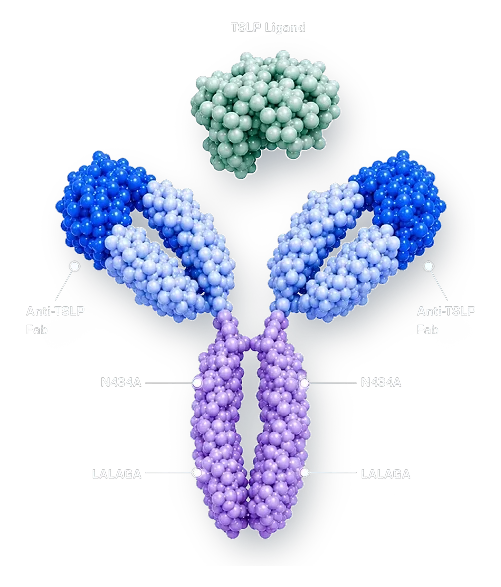
WIN378
Engineered to extend half-life and silence effector function
WIN378
WIN378 is a novel, fully human, ultra-long-acting monoclonal antibody that is designed to inhibit thymic stromal lymphopoietin (TSLP). This clinically validated target plays a key role in the development and progression of a wide array of immunological diseases, including asthma, chronic obstructive pulmonary disease (COPD), chronic rhinosinusitis with nasal polyps, and eosinophilic esophagitis. WIN378 was engineered for improved potency, extended half-life and silenced effector function. It is the only known investigational drug that blocks TSLP signaling by binding to two different sites on TSLP, interfering with binding of TSLP to both of its co-receptors on the cell surface of epithelial cells.

WIN378 is currently being evaluated in POLARIS-1, a Phase 2/3 study in severe, uncontrolled asthma. In a preplanned interim analysis from the Phase 2 dose-finding portion of the study, significant improvements in lung function and airway inflammation were observed with twice-yearly dosing of WIN378. The Phase 3 portion of POLARIS-1 is underway, and a second Phase 3 study (POLARIS-2) is planned to begin in the first half of 2027.
See POLARIS trial
WIN378 is also being evaluated in the Phase 2 SIRIUS study in moderate-to-severe chronic obstructive pulmonary disease (COPD), with the first patients dosed in June 2026.
See SIRIUS trial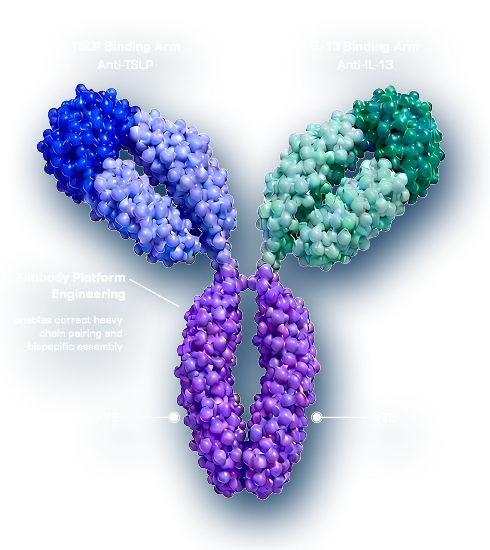
WIN027
Engineered to extend half-life
WIN027
WIN027 is a clinical-stage, ultra-long-acting bispecific monoclonal antibody designed to simultaneously target TSLP and IL-13, two clinically validated drivers of inflammatory disease.
By combining upstream TSLP inhibition with downstream IL-13 inhibition in a single molecule, WIN027 is designed to provide broader and deeper suppression than single-targeted mechanisms. WIN027 has been engineered for an extended half-life to support infrequent dosing and is being developed for respiratory and dermatologic diseases, including COPD and atopic dermatitis.
WIN027 is currently being evaluated in Phase 1 healthy volunteer clinical development, with Phase 2 studies planned in COPD and atopic dermatitis.
IL-13, interieukin-13; TSLP, thymic stromal lymphopoletin